
The Judges Saw It Coming: How Farmbot Went From Monitoring Water to a $15 Million Raise
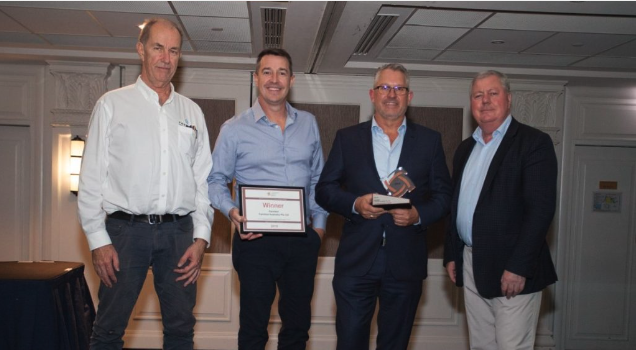
The Farmbot Founders receive their Award from Julian (Jolly) Day Founder & CEO of Consensus.
Farmbot | Consensus AgTech Award Winner 2019
When Farmbot stood before the Consensus judging panel in 2019, the proposition was deceptively simple: help farmers know what was happening with their water without having to physically drive out and check it.
The technology used satellite and cellular connectivity to remotely monitor water levels in tanks, dams and irrigation channels, sending near-real-time information and alerts directly to farmers.
It addressed a problem as old as Australian agriculture itself. Water is critical, properties are vast, infrastructure is remote, and discovering that a tank, pump or trough has failed too late can have serious consequences.
But the Consensus judges saw something bigger.
In awarding Farmbot a 2019 Consensus AgTech Award, the panel unanimously praised the Australian company across innovation, performance and potential. They recognised not only a compelling solution for the livestock sector, but the possibility that Farmbot could ultimately become a much broader data-monitoring solution for agriculture.
Seven years later, that prediction looks remarkably prescient.
From water runs to real-time data
Farmbot's original technology replaced one of farming's most routine jobs: physically travelling across a property to check water infrastructure.
Instead, farmers could remotely see what was happening and receive alerts when conditions changed.
That meant fewer unnecessary kilometres, less fuel and vehicle wear, faster responses to leaks and equipment failures, and critically, greater certainty around livestock water supply.
Early customer results demonstrated the practical value. Farmbot reported farmers reducing the time spent checking water by as much as 80%.
This wasn't technology looking for an agricultural problem to solve. It was technology built around a very real problem experienced every day on Australian farms.
Recognition was followed quickly by momentum
Only weeks after its Consensus win, Farmbot received a $597,650 Accelerating Commercialisation grant to broaden the application of its technology beyond its existing water-monitoring offering and further develop precision-agriculture applications.
In 2020, Farmbot was named Food & AgriTech of the Year in the Australian Technologies Competition, emerging from a field of 217 entries.
The following year it was recognised again, winning the Sustainability, CleanTech and AgTech category at the inaugural Technology Scale-Up Awards.
And the company kept growing.
By 2024, Farmbot had again been named Australian AgTech Scale-Up of the Year.
By 2025, it had passed another significant milestone: more than 10,000 Australian farmers, pastoralists and graziers were using Farmbot technology to monitor critical assets across their operations.
The little monitor sitting on a remote Australian water tank had become part of a much larger agricultural technology platform.
Then came the capital
In July 2026, Farmbot reached another major milestone, securing a $15 million Series B funding round.
According to CB Insights, the raise brought Farmbot's total disclosed funding to approximately $22 million across nine funding rounds, backed by a group of investors including Lewis & Clark Partners, Builders VC, Cultiv8 Funds Management, Fulcrum Global Capital, Lever VC and Macdoch Ventures.
For an Australian AgTech company solving what initially sounds like the simple problem of checking water levels, the trajectory is significant.
But perhaps that is exactly why Farmbot worked.
Its innovation wasn't about making agriculture more complicated. It was about using technology to remove an expensive, repetitive and sometimes risky task from farmers' lives.
Technology that works where farming happens
Farmbot's significance also lies in where its technology can operate.
Australian agriculture doesn't conveniently exist within reliable metropolitan communications networks. Farms can span enormous distances, with critical infrastructure located well beyond conventional connectivity.
Farmbot's use of satellite communications meant remote monitoring could extend into areas where traditional connectivity was limited or nonexistent.
A Meat & Livestock Australia digital farming trial subsequently demonstrated that Farmbot's satellite-enabled tank and trough monitoring could be reliably deployed in remote agricultural environments, while also highlighting the potential for a broader wireless sensor ecosystem.
What began with knowing how much water was in a tank was evolving into something much larger: connected infrastructure providing farmers with better information about what was happening across their properties.
The potential Consensus recognised in 2019
The Consensus Awards have always assessed technology differently.
Products are not simply compared against one another. Independent judges examine whether the technology demonstrates genuine innovation, delivers measurable performance benefits and, importantly, has the potential for further product or market development.
That final criterion matters when viewed retrospectively.
In 2019, the judges weren't assessing a company that already had 10,000 users or tens of millions of dollars in funding behind it.
They were assessing the potential.
They saw an Australian-developed technology combining remote monitoring, connectivity and a clear understanding of its customer to solve an important agricultural problem.
Today, Farmbot is still solving that problem — just at a vastly greater scale.
From a Consensus AgTech Award in 2019 to more than 10,000 users and a $15 million Series B seven years later, Farmbot is exactly the kind of Australian technology story the Consensus Awards were created to identify.